
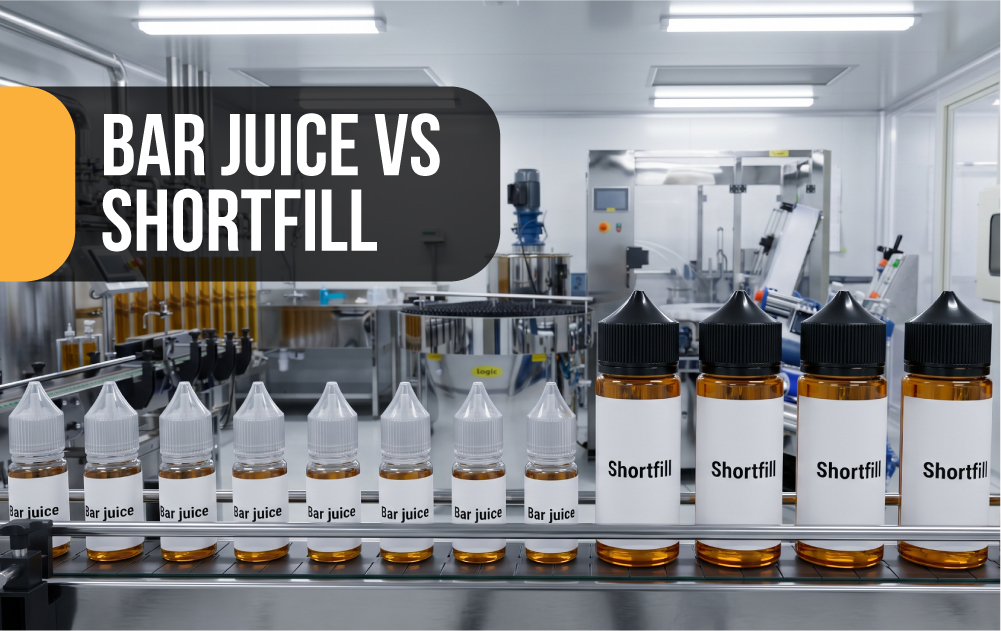
Most e-liquids are not competing with each other. They are built for different setups, and bar juice and shortfills are a good example of that. Often, they are compared side-by-side, but in reality, they serve different devices, nicotine preferences, and vaping styles.
Here’s what separates them and how to figure out which belongs in your kit.
Understanding Bar Juice and Shortfill E-Liquids
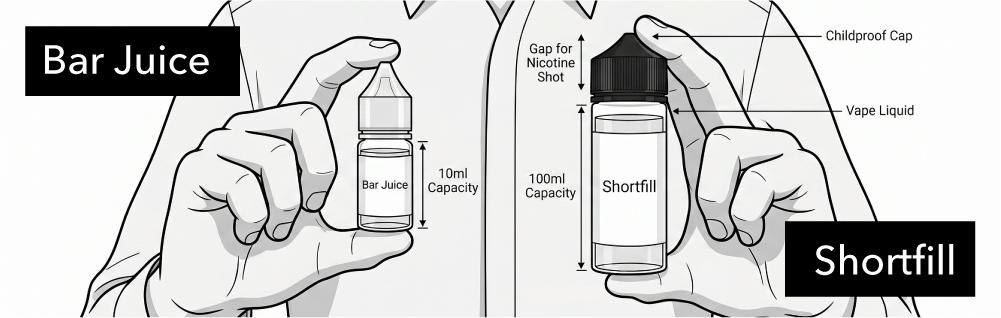
Just by looking, the difference between the two is simple. Bar juice is a small bottle, while shortfills are larger. But the distinction goes further than size. Nicotine type, VG/PG ratio, device compatibility, and even the vaping experience all factor in.
To make a clear comparison, it helps to look at each one on its own first.
What is a Bar Juice E-Liquid
Bar juice (commonly called bar salts) is a 10ml nicotine salt e-liquid crafted around the goal of matching the flavour intensity and nicotine hit of disposable vapes. The flavour formulation is intentionally intense and sweet, built using concentrated flavour compounds closely modelled on what disposables are so popular in the first place.
The nicotine salt base is what allows a 20mg to feel smooth. This happens because nic salts treat nicotine with benzoic acid, lowering the pH and making high concentrations comfortable to inhale, making it the most practical replacement for disposables after the UK ban came into force last June 2025.
Its 50/50 VG/PG ratio is deliberate by design. Pod coils and MTL devices need balanced viscosity. The liquid has to wick quickly through a small, tight coil at low wattage, and 50/50 does that efficiently. Open the bottle, fill the pod, and it is ready.
A shortfill is a nicotine-free e-liquid sold in a bottle larger than its contents. In context, a 100ml shortfill comes in a 120ml bottle, with 20ml of headspace left for two 10ml nicotine shots. Add both, and you get 120ml at roughly 3mg nicotine.
One nicotine shot lands at around 1.5mg, while a higher strength pushes it towards 6mg. Beyond 6mg, the ratio of liquid to shot changes enough that the flavour concentration drops noticeably.
The VG/PG ratio is also one of shortfill’s defining features. Most run at 70/30 high VG, which produces thicker, denser vapour and a smoother draw. Sub-ohm coils below 0.6ohm, running at 30 watts or more, are built around this kind of liquid. They heat a large mesh surface area and need a thick, high-viscosity e-liquid to saturate the surface properly.
Bar Juice and Shortfill Comparison Guide
|
Feature |
Bar Juice/Bar Salts |
Shortfill |
|
Nicotine Content |
10mg-20mg nic salts |
0mg until Nic shots are added |
|
Ideal Vaping Style |
Mouth-to-Lung/ Pod kits |
Direct-to-Lung/ Sub-ohm |
|
PG/VG Ratio |
50/50 |
70/30 High VG |
|
Flavour Profile |
Intense, sweet, disposable-inspired |
Smooth, rich, varied |
|
Convenience |
Ready to vape |
Requires Nic shot mixing |
The difference between bar juice and shortfills sold in the UK are shaped to meet the e-liquid minimum standards for safety set out under the Tobacco and Related Products Regulations (TRPR), overseen by the MHRA. This covers nicotine strength limits, ingredient restrictions, labelling guidelines, and the requirement for all products to be notified and published by the MHRA before reaching shelves.

Which One Is Right for You
There is no universal “better” option between the two. The right choice depends on how you vape. Generally, the device you are using and your nicotine preference. Here’s how you can match those factors to the right e-liquid:
Pick bar juice if:
-
You use a starter kit or any MTL device (coils above 0.8 ohm)
-
You want higher nicotine strengths
-
You prefer a smoother inhale with a noticeable throat hit
-
You want something ready to vape with no mixing involved
-
You want the same flavour intensity of disposables in a refillable kit
-
You prefer a simple, portable setup with no bottle prep
Pick a shortfill if:
-
You use a sub-ohm kit or any high-wattage device
-
You prefer lower nicotine levels, or none at all
-
You want larger, denser vapour production in every draw
-
You think of nicotine as an option and find it comfortable adding on your own

Can You Use Both Bar Juice and Shortfill
A lot of vapers use bar juice and shortfill simultaneously. But the key point is that both e-liquids working together require two devices. Swapping the liquid between a single device does not work. This is because high VG in a pod coil leads to dry hits, while a 50/50 bar salt in a high-wattage device floods and spits. The incompatibility is with the coil, not with the concept of using both e-liquids in general.
Why the Coil Decides Everything
Higher-resistance coils above 0.6 ohms operate at low wattage with narrow wicking ports. They need a lower-density, balanced liquid to pull through the cotton fast enough to keep up with each draw. Conversely, high VG is too thick for that flow rate. The cotton cannot absorb it between puffs, and the coil runs dry, burning the cotton and producing that harsh, acrid taste.
Sub-ohm coils below 0.6 ohms run hotter, draw more liquid per pull, and heat across a much larger surface area. They need a liquid with enough weight and density to stay saturated across that surface at a higher wattage. And 50/50 bar juice is too thin for that. It saturates unevenly and floods the base of the coil instead of distributing it across the mesh.
As both mistakes are common, they are equally avoidable by matching your choice of e-liquid to the device from the start.
Where Bar Juice and Shortfill Fit
Testing different types of e-liquid is not wrong. There are plenty of vapers who land on the right one by accident. But there is a practical difference between using a liquid just because it works and knowing why it works. The second one scales. It means fewer wasted purchases, fewer unexplained problems, and a good sense of what to look for when your device changes.
Bar juice and shortfills are two well-established e-liquids with distinct purposes. And now that those purposes are clear, the choice between them stops being a guess.